AIoTCoE
AIoT Center of Excellence (AIoTCoE)
Build and scale AI at the edge—with safety, speed, and ROI.
Executive Summary
The AIoT Center of Excellence is a practitioner-led forum where OT/IT engineers, data/ML teams, product leaders, and ecosystem partners turn AI + IoT into reliable, repeatable outcomes. We publish chartered workstreams, reference architectures, playbooks, evaluation suites, and evidence packs so organizations can deploy classical ML, computer vision, forecasting, and (where appropriate) agentic techniques across devices, edge, and cloud—with governance built in.
Mission and Purpose:
Drive collaboration across key industries to identify effective ways of using AI to address existing and emergent challenges and opportunities by sharing:
- Use cases applicable across industries as well as those in specific sectors
- Challenges faced with different data sources on a variety of decisions
- The importance and successes in incorporating domain knowledge into the AI approaches
- Success stories and how they were achieved
- Challenges and successes with taking analytics to streaming data, supporting real time decisions to improve business success by transforming from reactive decisions, to predictive & prescriptive decision making
- Sharing challenges and successes in taking the analytics to where the data is: to the edge
Who We Serve
- Practitioners: OT/IT architects, edge engineers, data scientists/ML engineers, MLOps/AIOps owners, SRE/observability leads.
- Operations & Product: manufacturing/plant ops, logistics and field ops, facilities/energy managers, product managers.
- Security & Compliance: CISOs, product security, risk and audit teams.
- Leadership: CIO/CTO/CDO/COO, heads of AI/Analytics and Digital Transformation.
- Partners: platforms, silicon and accelerator vendors, integrators/SIs, ISVs, standards bodies, academia.
Charter & Objectives
- Time-to-Value: shorten cycle from idea → pilot → production.
- Reliability: deterministic behavior at the edge; graceful degradation offline.
- Cost & Performance: right-sizing models and hardware per SLA and TCO.
- Governance & Safety: policy gates, human-in-the-loop (HITL), rollback, and audit trails.
- Interoperability: open interfaces across device, edge, platform, and enterprise systems.
- Skills: role-based upskilling and patterns that non-ML teams can operate.
Focus Pillars
- Edge ML Lifecycle & MLOps
– What: dataset creation, labeling, feature engineering, model training, packaging (ONNX, TensorRT, OpenVINO, etc.), deployment, monitoring/drift, and retraining loops.
– Why: stable pipelines and versioned artifacts are the difference between demos and durable operations.
– Starter outcomes: reproducible builds, drift alerts, rollback recipes, cost/performance dashboards. - Computer Vision at the Edge
– What: quality inspection, safety/compliance (PPE zones, no-go areas), inventory and planogram checks, OCR for meters/labels; privacy-preserving processing with on-device blurring/redaction.
– Why: cameras are abundant; the gap is reliable, low-latency inference and maintainable models.
– Starter outcomes: packaged vision pipelines (+ calibration, lighting guidance), precision/recall targets, false-positive budgets. - Time-Series & Anomaly Detection
– What: condition monitoring, predictive maintenance, energy and process optimization; multivariate forecasting with external signals (weather, tariffs).
– Why: telemetry is plentiful; we need robust features, windows, and alerting that operators trust.
– Starter outcomes: feature libraries, windowing patterns, thresholds + learned detectors, action playbooks. - Optimization & Scheduling
– What: production scheduling, crew/route optimization, setpoint tuning, load shaping under tariff/carbon constraints.
– Why: model insights must change plans, setpoints, or sequences to matter.
– Starter outcomes: solver patterns (MILP/heuristics/hybrid), constraint libraries, “what-if” sandboxes. - Digital Twins & Simulation-in-the-Loop
– What: process, cell/line, site, or fleet twins to test changes before execution; data contracts to keep twins live.
– Why: safe experimentation and faster approvals.
– Starter outcomes: twin adapters, validation harnesses, “simulate-then-apply” checklists. - Agentic Orchestration (Bounded)
– What: agents that triage, summarize, or propose actions; all actions gated by policy, identity, and HITL.
– Why: to reduce operator burden while maintaining control and auditability.
– Starter outcomes: tool catalogs, action whitelists/blacklists, approval checkpoints, safe prompts.
Reference Architecture
- Device & Sensors: machines, cameras, gateways, meters; hardware-backed identity where possible.
- Connectivity: deterministic and non-deterministic (wired, Wi-Fi/5G/LPWAN); segmentation and traffic classes tied to SLA.
- Edge Runtime: containerized services, accelerators (CPU/GPU/NPU), protocol adapters, time-sync, buffering, quality checks, offline-first modes.
- Platform & Data: streaming ingestion, time-series/events, object storage/lakehouse, feature stores, lineage/catalog, model registry.
- Applications & Integrations: CMMS/EAM, MES/MOM, BMS/EMS, WMS/TMS, ERP/PLM, dashboards, copilots/assistants; webhooks/APIs for closed-loop actions.
- Governance & Safety: policy-as-code, HITL approvals, rollback and incident runbooks, evaluation suites, audit evidence.
Deliverables
- Reference Architectures with BOM considerations and design rules.
- Evidence Packs (policy → control → artifacts).
- Masterclasses (edge ML, vision, time-series, optimization, governance).
Cadence & Calendar
- Monthly working session (60–90 min): Discussion, design reviews, decisions.
- Quarterly showcase (2–3 hours): cross-org demos and outcomes.
- Annual anchors: aligned to IoT Slam programming; deep dives, and masterclasses.
Participation Levels
- Member: attend, learn, and provide feedback.
- Contributor: bring use cases, share artifacts, review drafts, join a workstream.
- Workstream Lead: drive deliverables to closure and present outcomes.
- Chair/Steering: set direction, resolve blockers, uphold governance/quality bars.
How to Get Involved
• Join the AIoTCoE and select a workstream: https://iotcommunity.net/join-us/
• Sponsor a workstream or propose a pilot: sponsors [at] iotcommunity [dot] net
How We Succeed
By establishing ourselves as a global Healthcare industry source of truth and trusted advisor:
- Learning portal and knowledge platform
- Center of Excellence content approach
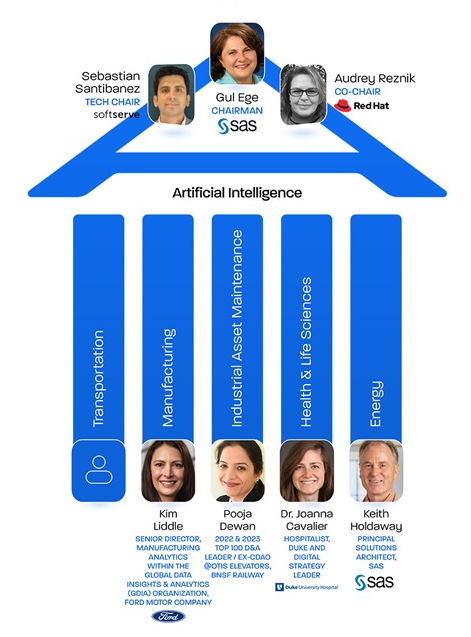
- Transportation
- Manufacturing
- Industrial Asset Maintenance
- Health & Life Sciences
- Energy
- Live conferences and on-demand dissemination
The IoT Community® AIoT CoE accelerates practical AI + IoT adoption with open, repeatable patterns you can operate. We connect practitioners, leaders, and partners to deliver measurable outcomes—grounded in governance, evidence, and a community that ships.