IMIoTCoE
Industrial & Manufacturing IoT Center of Excellence (IMIoTCoE)
Modernize OT without stopping the line—safer, smarter, more efficient factories.
Executive Summary
The Industrial & Manufacturing IoT CoE is a practitioner-led forum where plant, process, and product teams co-create proven patterns for smart manufacturing. We publish chartered workstreams, reference architectures, playbooks, evaluation suites, and audit-ready evidence to help discrete, process, and hybrid manufacturers lift OEE, reduce scrap and energy intensity, shorten changeovers, and improve safety—without disrupting validated operations.
Our Mission & Purpose
Accelerate industry transformation through the convergence of IT/OT and transformative technologies that are empowering new use cases and furthering the vision for the future of manufacturing.
These transformative technologies, traditionally not defined in the OT environment, like advanced vision systems, 3D printing, AGVs, Cobots and mobile computing and next generation IT technologies, like workflow orchestration and applied AI/ML are redefining Human -to-Machine convergence.
The industry needs guidance on adopting these innovations and best practices. As a catalyst, the Intelligent Manufacturing IoT Center of Excellence brings end users, academia and solution providers together to influence adoption of these edge-to-cloud transformation for a vibrant sustainable future for all.
Who We Serve
- Plant & Operations: production managers, line supervisors, maintenance leaders, reliability engineers.
- OT/IT & Engineering: controls/automation (PLC/SCADA/DCS), MES/MOM, edge architects, connectivity/network leads.
- Quality & Compliance: quality engineers, validation, regulatory/QA, EHS.
- Data/AI & Product: data scientists/ML engineers, process engineers, product owners, industrial data platform teams.
- Leadership: COO, VP Ops/Manufacturing, CIO/CTO/CISO, Heads of Digital/Industry 4.0, Sustainability leaders.
- Partners: OEMs, system integrators, ISVs, standards bodies, academia, and supply-chain partners.
Charter & Objectives
- OEE Uplift: practical pathways to raise availability, performance, and quality.
- Brownfield Enablement: retrofit patterns that respect existing assets and safety cases.
- Quality & Traceability: reduce escapes and scrap; strengthen genealogy and SPC.
- Changeover & Flexibility: faster SMED-style changeovers with fewer defects on restart.
- Energy & Sustainability: lower energy per unit and embedded carbon—without compromising throughput.
- Safety & Governance: action guardrails, rollback, and evidence that auditors accept.
- Skills & Scale: repeatable playbooks that non-data teams can operate.
Focus Pillars
- Integration & Master Data
– Map ERP↔MES↔SCADA/PLC with clean master data, lot/recipe/version control.
– Starter outcomes: practical tag/parameter models, material and order alignment, work-center KPIs that match financials. - Digital Twins of Cell/Line & What-If Simulation
– Physics/flow-aware twins to test schedule changes, recipe tweaks, and staffing before execution.
– Starter outcomes: sandbox for “simulate-then-apply,” bottleneck visualization, run-at-rate and changeover rehearsal. - Predictive Quality, SPC & Genealogy
– Vision + sensor fusion for defects; SPC streaming with auto-hold/release logic; end-to-end part/batch genealogy.
– Starter outcomes: escapes ↓, FPY ↑, golden batch/lot references, electronic records linked to actions. - Maintenance & Asset Health (PdM/CbM)
– Condition monitoring for rotating equipment; anomaly detection; CMMS auto-workorders with parts verification.
– Starter outcomes: unplanned downtime ↓, MTBF ↑, first-time-fix ↑, spare parts optimization. - Robotics & Cobots (Safety-First)
– Safe zones, task allocation, AI vision guidance, ergonomic assist; ISO 10218/TS 15066 profiles.
– Starter outcomes: reduced cycle time without safety regressions; teach-by-demonstration patterns with audit logs. - Energy & Sustainability in Production
– Energy/steam/compressed air optimization; tariff/carbon-aware scheduling; per-SKU carbon accounting.
– Starter outcomes: energy per unit ↓, off-peak load shaping, line-level CO₂e visibility tied to OEE.
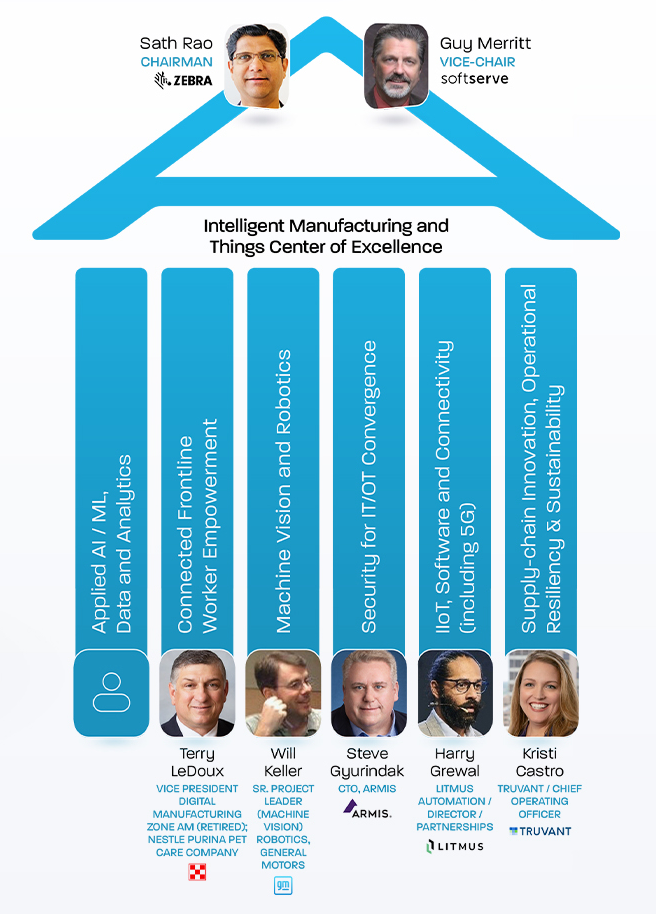
The emerging interest areas for the CoE (pillars) are currently identified as:
- Applied AI/ ML, Data and Analytics
- Connected Frontline Worker Empowerment
- Machine Vision and Robotics
- Security for OT
- IIoT, Software and Connectivity (including 5G)
- Supply-chain Innovation
Reference Architecture
- Device & Field Layer: PLCs, sensors, drives, robots/cobots, cameras, meters—hardware-backed identity where possible.
- Connectivity: deterministic (TSN/industrial Ethernet) + non-deterministic (Wi-Fi/5G); segmentation and traffic classes by SLA.
- Edge Runtime: protocol adapters, time-sync, buffering, quality checks; low-latency vision; offline-first; signed artifacts.
- Platform & Data: streaming ingestion; time-series/events; lakehouse; feature store; lineage/catalog; model registry.
- Apps & Integrations: MES/MOM, CMMS/EAM, QMS/SPC, ERP/PLM, WMS/TMS; dashboards; copilots/assistants; APIs for closed-loop actions.
- Governance & Safety: policy-as-code, HITL approvals for sensitive actions, rollback, incident drills, evaluation suites, and audit evidence.
How We Succeed?
By establishing an eco-system of self-sustaining collaboration between end-uses, academia and solution providers that encourage:
- Knowledge sharing of roadmaps, technology and approaches toward the transformative future
- Build an annual agenda of focus topics and experts who can inspire the vision for the transformation through virtual and live interactive sessions
- Interactions within the manufacturing eco-system, share ideas and approaches
- Provide relevant content in a consumable form and expand awareness of challenges, solutions and outcomes
Programs & Workstreams
- Brownfield Retrofit Kits: protocol gateways, tag maps, edge containers, safety notes.
- Vision Quality Starter: lighting/calibration guides, model templates, precision/recall targets, reject/repair workflows.
- PdM Blueprint Pack: feature windows, anomaly thresholds, CMMS integration, parts verification.
- Changeover & SMED Accelerator: parameter sets, validation checklists, golden batch comparisons.
- SPC & Genealogy Patterns: streaming SPC, auto-hold rules, genealogy joins to orders/materials.
- Robot/Cobot Safety & Orchestration: zone definitions, task allocation, interlocks, audit logs.
- Energy-Aware Scheduling: tariff/carbon routing; comfort/throughput guardrails for ovens/furnaces/HVAC.
Deliverables
- Reference Architectures with design rules and BOM considerations.
- Blueprint Cards (problem → pattern → steps → KPIs → risks → evidence).
- Runbooks (install, operate, upgrade, rollback; validated change).
- Evaluation Suites (quality/throughput, latency/jitter, safety checks, cost).
- Evidence Packs (policy → control → artifacts; change logs, approvals, test results).
- Masterclasses (ISA-95/88, edge vision, SPC, PdM, SMED, governance).
Cadence & Calendar
- Monthly working session (60–90 min): backlog, design reviews, decisions.
- Annual anchors: aligned to IoT Slam; plugfests, deep dives, and masterclasses.
Participation Levels
- Member: attend, learn, and provide feedback.
- Contributor: bring use cases, share artifacts, review drafts, join a workstream.
- Workstream Lead: drive deliverables to closure and present outcomes.
- Chair/Steering: set direction, resolve blockers, uphold governance/quality bars.
How to Get Involved
- Join the IMIoTCoE and select a workstream: https://iotcommunity.net/join-us/
- Sponsor a workstream or propose a pilot: sponsors [at] iotcommunity [dot] net
The IoT Community® IMIoT CoE accelerates smart manufacturing with open, repeatable patterns that practitioners can run. We connect plant leaders, engineers, and partners to deliver measurable outcomes—grounded in safety, governance, and a community that ships.