Mobility & Connectivity
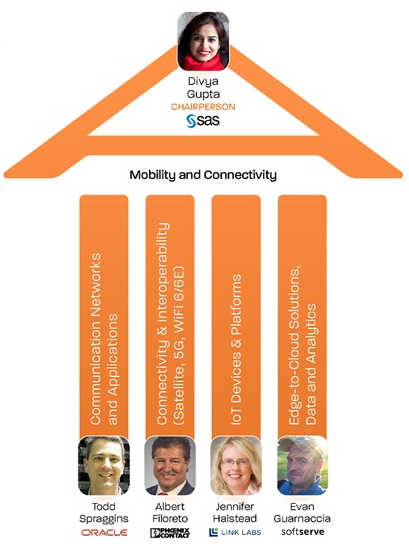
Mobility & Connectivity IoT Center of Excellence (MCIoTCoE)
Right link, right SLA, right cost—every device, everywhere.
Executive Summary
The Mobility & Connectivity IoT CoE helps practitioners design, deploy, and operate resilient, cost-effective connectivity for devices, vehicles, sites, and mobile workers. From Wi-Fi 6/7 and private 5G to LPWAN and LEO satellite, the CoE turns complex access choices into clear, repeatable patterns—backed by governance, observability, and evidence. We publish reference architectures, playbooks, evaluation suites, and audit-ready artifacts so organizations can meet SLA targets (latency, jitter, throughput, uptime, battery life) while controlling risk and spend.
Who We Serve
- Practitioners: network architects/engineers, RF planners, site reliability/edge platform teams, mobility leads, device/firmware engineers.
- Operations: field service/fleet leaders, store/branch IT, utilities operations, logistics and depot/yard managers.
- Security & Compliance: CISOs, product security, risk/audit, privacy and cross-border data leads.
- Leadership: CIO/CTO/COO, heads of Infrastructure/Networks, Digital/Industry programs.
- Partners: operators/MVNOs, satellite providers, Wi-Fi/private cellular vendors, integrators/SIs, standards bodies, academia.
Our Mission and Purpose
To accelerate the development and adoption of IoT technologies that enhance mobility and connectivity by providing a collaborative platform for industry experts, researchers, and innovators. The MCIoTCoE aims to:
- Facilitate knowledge sharing and innovation in IoT-enabled mobility and connectivity solutions.
- Develop best practices and standards that ensure the reliability, security, and scalability of connected systems.
- Support the deployment of IoT solutions that drive efficiency, reduce environmental impact, and improve safety in mobility and connected infrastructures.
- Empower members of the IoT community to lead in creating transformative, real-world applications of mobility and connectivity technologies.
Charter & Objectives
- Fit-for-Purpose Access: match workloads to access (Wi-Fi 6/7, private/public 4G/5G/RedCap, LPWAN, fiber, LEO/MEO) with clear envelopes.
- Reliability & Performance: predictable latency/jitter/throughput; graceful degradation with bonding/failover.
- Mobility at Scale: roaming, handoff, and multi-access continuity for fleets, field ops, and pop-up sites.
- Security & Governance: identity (eSIM/iSIM), segmentation, policy-based routing, SASE/zero-trust, and audit evidence.
- Cost & Energy: minimize backhaul and per-byte charges; extend device battery life; optimize spectrum/coverage.
- Skills: enable teams with playbooks that non-RF specialists can run.
How We Succeed
Our charter is to provide meaningful and actionable insights around the topics of Mobility and Connectivity. We will provide industry input to established IoT frameworks and standards, provide industry master classes, use-cases, and best practice advice. This CoE will bring together a team of IoT icons whose knowledge in the Mobility and Connectivity domain is helping to shape the future of the IoT.
- Live conferences and on-demand dissemination – to include the introduction of a yearlong master class series hosted by world leading experts
- Learning portal and knowledge platform – to include business use cases, presentations, best practices
- Create expert thought leadership teams to identify, study and develop best practices and industry deliverables to support the IoT practitioner.
Scope
The Mobility and Connectivity Center of Excellence (MCIoTCoE) within the IoT Community is dedicated to advancing and integrating cutting-edge mobility and connectivity solutions across industries. This includes the exploration, development, and deployment of innovative IoT technologies that enhance the efficiency, safety, and sustainability of connected systems. The CoE focuses on fostering collaboration, sharing best practices, and driving the adoption of IoT solutions that enable seamless communication between devices, vehicles, infrastructure, and users.
Focus Pillars
- Access Strategy & Envelopes
– What: decision trees that map use cases to access options with realistic latency/throughput/coverage/battery envelopes.
– Starter outcomes: “good/better/best” matrices per workload (telemetry, vision, control, POS/branch, telemed, AGV/robot). - Private 4G/5G & Wi-Fi 6/7 Convergence
– What: site patterns combining Wi-Fi for LAN density with private cellular for mobility/QoS; VLAN/VRF and identity-aware segmentation.
– Starter outcomes: reference topologies, coverage targets, QoS maps, and safe coexistence in 6 GHz. - LPWAN for Massive IoT
– What: LoRaWAN vs NB-IoT/LTE-M trade-offs (payload/interval, mobility, energy, TCO), duty-cycle, and backhaul minimization.
– Starter outcomes: battery-life calculators, payload design rules, and edge filtering patterns. - Non-Terrestrial Networks (NTN) & LEO Backup
– What: satellite as resilience layer for remote/critical sites, auto-failover with bounded costs and data minimization.
– Starter outcomes: bandwidth guards, compression/redaction, store-and-forward rules. - eSIM/iSIM & Identity at Scale
– What: remote SIM provisioning, SM-DP+/profiles, eUICC policy, per-device identity binding to network policy.
– Starter outcomes: provisioning runbooks, profile rotation, lost/stolen/device-sell-off procedures.
Reference Architecture
- Device & Modem Layer: sensors/edge gateways/vehicles/handhelds; eSIM/iSIM; secure boot and per-device identity.
- Access: Wi-Fi 6/7 (incl. 6 GHz), private LTE/5G (RedCap where applicable), public 4G/5G, LPWAN (LoRaWAN/NB-IoT/LTE-M), fiber, and LEO/MEO satellite.
- Transport & Security: SD-WAN/SASE, IPsec/TLS, policy-based routing, segmentation (VLAN/VRF), optional 5G slicing/QoS classes.
- Edge & MEC: local break-out for latency-sensitive workloads (vision, control), protocol adapters, buffering, quality checks.
- Core/Cloud: aggregation, identity/AAA, device management, data pipelines, observability, and cost controls.
- Governance: policy-as-code (who can send what, where, when), approval checkpoints for sensitive changes, rollback and audit trails.
Deliverables
- Reference Architectures with design rules and BOM considerations.
- Masterclasses (Wi-Fi/Private 5G/LPWAN/eSIM/SD-WAN, observability).
Cadence & Calendar
- Monthly working session (60–90 min): backlog, design reviews, decisions.
- Quarterly showcase (2–3 hours): cross-site demos and outcomes.
- Annual anchors: aligned to IoT Slam; plugfests and deep dives.
Participation Levels
- Member: attend, learn, provide feedback.
- Contributor: bring use cases, share artifacts, review drafts, join a workstream.
- Workstream Lead: drive deliverables to closure and present outcomes.
- Chair/Steering: set direction, resolve blockers, uphold governance/quality bars.
How to Get Involved
- Join the MCIoTCoE and select a workstream: https://iotcommunity.net/join-us/
- Sponsor a workstream or propose a pilot: sponsors [at] iotcommunity [dot] net
The IoT Community® Mobility & Connectivity IoT CoE delivers practical, repeatable patterns to connect devices and operations reliably and affordably. We bring together practitioners, leaders, and partners to ship outcomes—grounded in governance, evidence, and a community that scales.