Healthcare IoT Center of Excellence (HIoTCoE)
Safe, connected, and compliant care—turning clinical signals into better decisions and outcomes.
Executive Summary
The Healthcare IoT Center of Excellence is a practitioner-led forum where clinicians, biomedical/clinical engineering, facilities leaders, IT/OT security teams, and industry partners co-create proven patterns for connected care. We publish chartered workstreams, reference architectures, playbooks, and evidence packs that help hospitals, clinics, labs, and life-sciences organizations deploy IoT and edge intelligence safely, reliably, and with measurable impact on patient outcomes, staff experience, and cost.
Who We Serve
- Clinical Engineering & Operations: biomedical engineers, clinical technology managers, field service leaders.
- Nursing & Clinical Ops: CNIO/CMIO support staff, unit leaders, patient safety and alarm committees.
- Facilities & Environment of Care: facilities managers, BMS/BAS operators, energy and IAQ leads.
- IT/OT, Data & Security: network architects, identity/segmentation owners, data/ML teams, CISOs.
- Leadership: CIO/CTO/CISO, VP Clinical Engineering, Directors of Facilities/Operations, Chief Digital/Transformation Officers.
- Partners: device manufacturers, platforms, integrators, cybersecurity providers, standards bodies, academia, and payer/provider alliances.
Charter & Objectives
- Safety: reduce nuisance alarms and adverse events while maintaining clinical guardrails.
- Uptime: increase biomedical device availability and reduce hunt time.
- Flow: improve OR utilization, bed turnover, and patient/asset movement.
- Data Quality: make clinical telemetry reliable, observable, and audit-defensible.
- Environment of Care: raise IAQ/comfort compliance hours and lower energy per occupied hour.
- Compliance: map patterns to sector regs and accreditation requirements with evidence that auditors accept.
- Skills: uplift practitioner capability via masterclasses, labs, and speaker/author development.
Scope & Boundaries
In scope: medical device connectivity and cybersecurity, clinical telemetry and alarm management, RTLS and flow, facilities/IAQ in clinical spaces, GxP data/compute for life sciences, and applied AI/analytics for triage and uptime (with human-in-the-loop guardrails). Out of scope: clinical diagnosis, treatment recommendations, or any activity that substitutes for clinician judgment.
Focus Pillars
- Medical Device Security & Trust
– What: identity/attestation, clinical-safe patching, micro-segmentation, SBOM/VEX, supplier assurance.
– Why: protect care continuity while reducing exposure from legacy devices.
– Starter outcomes: verified identity coverage, patch SLAs with compensating controls, documented network zones. - Clinical Telemetry & Observability
– What: waveforms, vitals, pump/device events; time-sync; lineage and data quality; routing to EHR/analytics.
– Why: trustworthy signals are prerequisite to meaningful analytics and GenAI.
– Starter outcomes: SLOs for freshness/completeness, quarantine of bad feeds, unified metric/trace logs. - Alarm Management & Patient Safety
– What: alarm policy design, escalation chains, alarm hygiene analytics, staff training and review cycles.
– Why: reduce fatigue, speed alarm-to-action, improve patient safety.
– Starter outcomes: 20–40% reduction in nuisance alarms while preserving true-positive capture; documented overrides and audits. - RTLS & Flow
– What: locate assets/patients/staff, streamline equipment turns and discharge orchestration, reduce hunt time.
– Why: faster care, higher utilization, less staff frustration.
– Starter outcomes: 50–80% hunt-time reduction, improved OR and bed throughput. - AI/Analytics for Triage and Uptime
– What: explainable triage aids, biomedical predictive maintenance, privacy-preserving analytics, and copilots for biomed/clinical workflows.
– Why: guide faster, safer actions without overloading staff.
– Starter outcomes: reduced time-to-resolve work orders, improved first-time-fix, safe prompts/policies with HITL approvals.
Reference Architecture
- Device & Sensor Layer: medical devices, pumps, monitors, ventilators, RTLS tags, IAQ sensors; identity and secure boot where possible.
- Connectivity: segmented VLANs/SDN, clinical Wi-Fi, wired, TSN where required; inline enforcement and observability taps.
- Edge & Gateway: protocol adapters, time-sync, local buffering/quality checks, redaction where needed, offline-first behavior.
- Platform & Data: streaming ingestion, time-series/event stores, semantic models (patient/asset/room), lineage and catalog.
- Applications: EHR/EMR, CMMS/EAM, RTLS dashboards, BMS/FDD, alarm consoles, analytics/AI tools with audit trails.
- Governance & Safety: policy-as-code (who can act, on what, when), change control, human-approval checkpoints, rollback, and evidence capture.
Deliverables
- Reference Architectures: device → network → edge → platform → data/AI → apps → governance.
- Masterclasses: practitioner-first learning paths with labs and capstones.
Cadence & Calendar
- Bi-monthly working session (60–90 minutes): Directions, design reviews, decisions.
- Quarterly showcase (2–3 hours): cross-organization demos and outcomes; public replay where appropriate.
- Annual anchors: aligned to IoT Slam programming; deeper dives, and masterclasses.
Participation Levels
- Member: attend, learn, and provide feedback.
- Contributor: bring use cases, share artifacts, review drafts, join a workstream.
- Workstream Lead: drive deliverables to closure, coordinate contributors, present outcomes.
- Chair/Steering: set direction, resolve conflicts, ensure governance and quality bars.
- Interested in leading a workstream? Email: healthcare [at] iotcommunity [dot] net
How We Succeed
By establishing ourselves as a global Healthcare industry source of truth and trusted advisor:
- Learning portal and knowledge platform
- Center of Excellence content approach
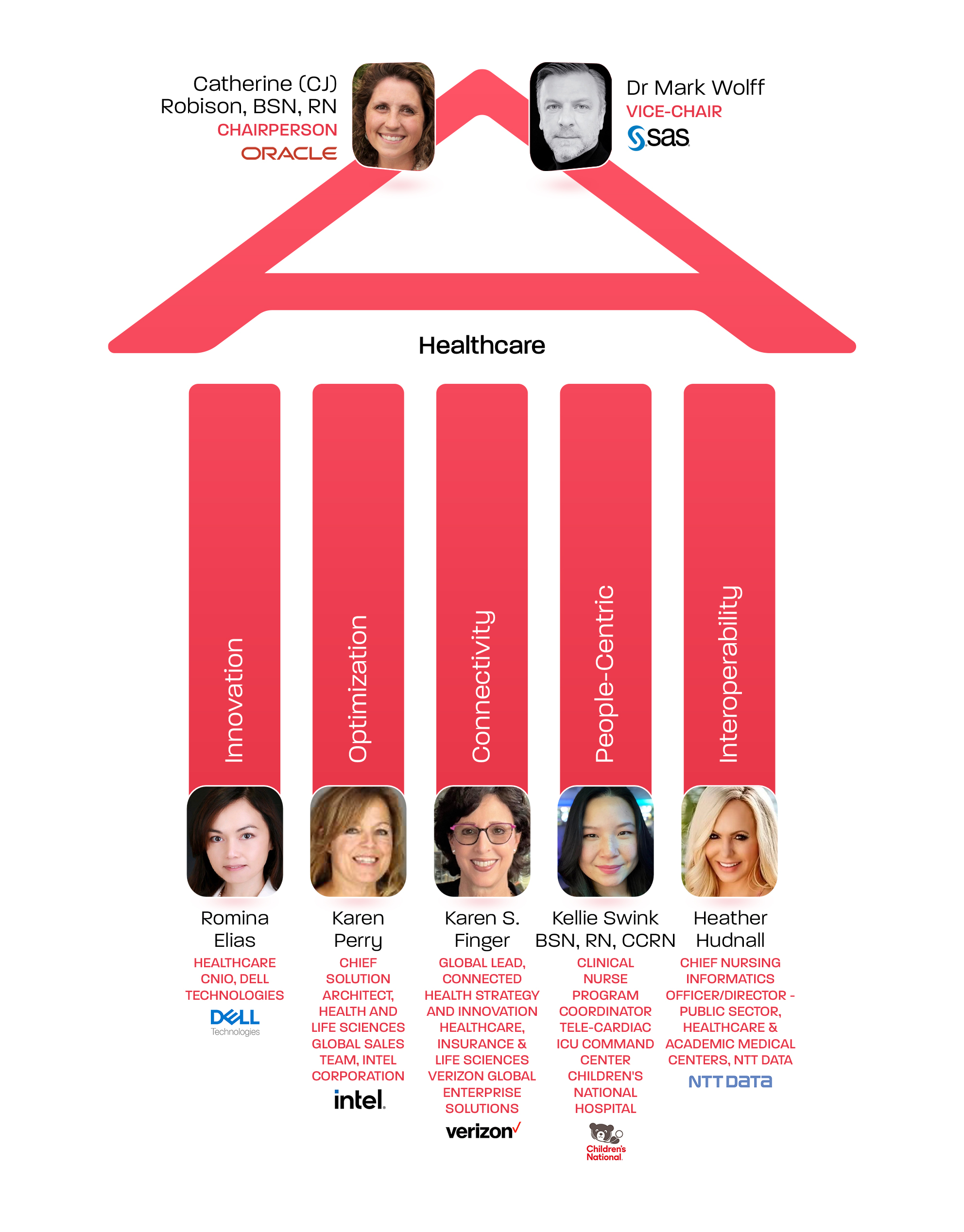
- Optimization
- Regulation
- Interoperability
- People-Centric
- Innovation
- Live conferences and on-demand dissemination
How to Get Involved
- Join the HIoTCoE and select a workstream: https://iotcommunity.net/join-us/
- Sponsor a workstream or propose a pilot: sponsors [at] iotcommunity [dot] net
The IoT Community® Healthcare IoT CoE is a practitioner-led forum dedicated to safer, more connected, and more efficient care. We produce open, practical, and repeatable patterns that healthcare organizations can adopt with confidence—grounded in governance, evidence, and a community that ships.